What people usually mean
In modern retail language, indica often signals “cozy” while sativa often signals “bright.” That shorthand is popular. It is also incomplete.
The quick answer
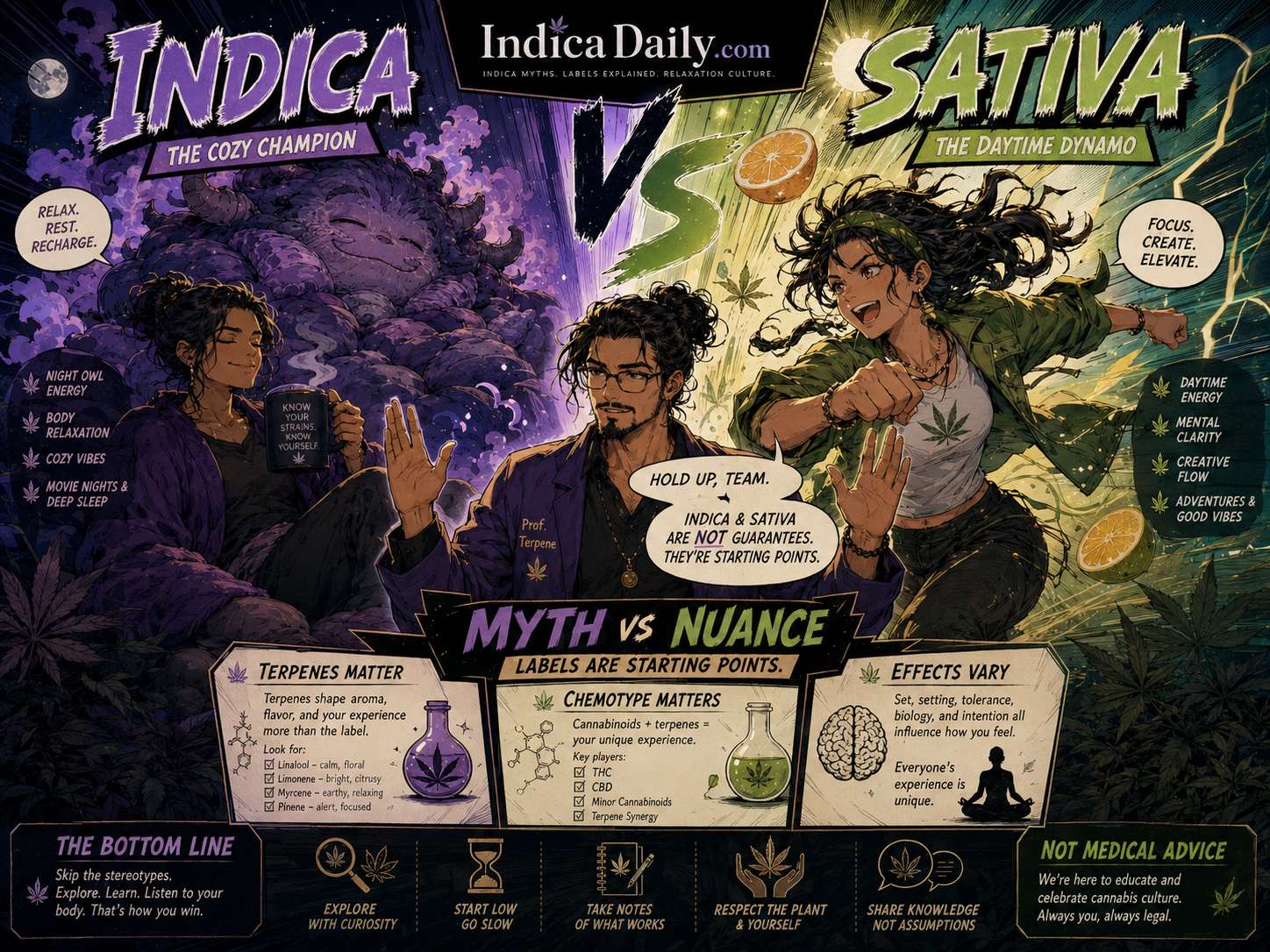
Indica is commonly marketed as relaxing, evening-friendly, body-heavy, or calm. Sativa is commonly marketed as uplifting, daytime-friendly, cerebral, or creative. But neither word can guarantee how you will feel.
Moon, blanket, couch.
Often presented as nighttime, relaxing, mellow, body-forward, and slow. Useful as a cultural signal, but not a personal prediction.
Sun, citrus, ideas.
Often presented as daytime, energetic, social, creative, and bright. Useful as a market signal, but still not a promise.
The myth problem
The indica-versus-sativa story becomes misleading when it turns into a rigid formula: indica equals sleep, sativa equals energy, hybrid equals balance. Real products are more complicated than that.
The real factors behind the experience
Professor Terpene does not throw away the categories. He just refuses to stop there. These factors are more useful than a single word on the front of the package.
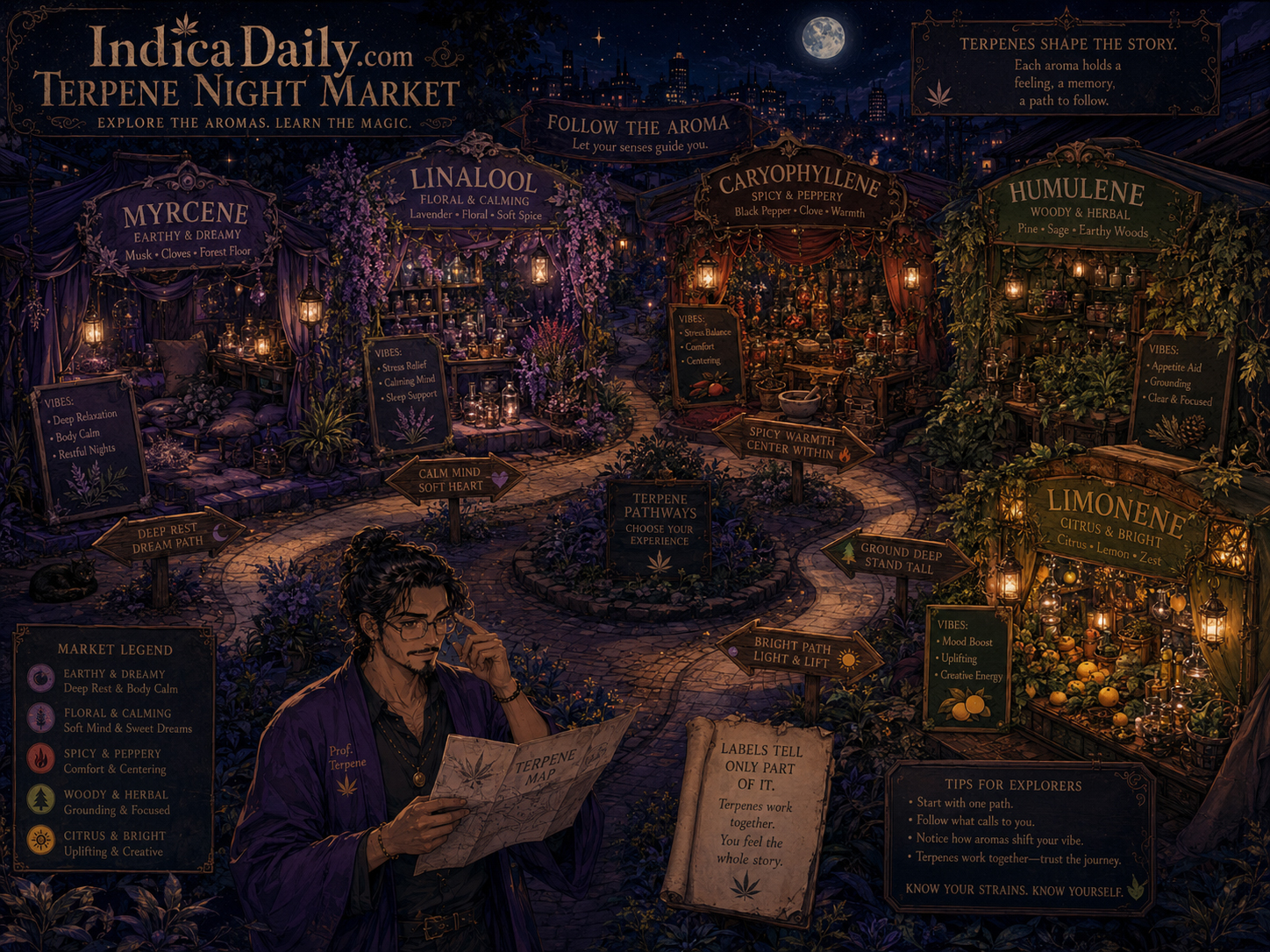
Aroma clues such as myrcene, limonene, linalool, pinene, humulene, and caryophyllene.
THC, CBD, and minor cannabinoids can shape potency, balance, and character.
More is not automatically better. Edibles especially require patience.
Your mood, location, company, food, hydration, and expectations all matter.
Tolerance, metabolism, prior experience, and biology can change the outcome.
How to compare products more intelligently
Instead of asking only “is it indica or sativa,” compare the whole label. The label will not predict everything, but it gives you a better map.
| Question | Why it helps |
|---|---|
| What is the category? | Indica, sativa, or hybrid can provide a starting expectation. |
| What are the THC and CBD levels? | Potency and balance can matter more than the category name. |
| What terpenes are listed? | Terpenes offer aroma clues and may help explain why products feel different. |
| What is the product type? | Flower, edible, vape, tincture, and concentrate experiences can differ widely. |
| Is there batch or lab information? | Testing and traceability are part of responsible label literacy. |
| What warnings are listed? | Ingredients, timing, storage, and use warnings should never be ignored. |
What about hybrids?
“Hybrid” is often used for products marketed as somewhere between indica and sativa. That does not automatically mean balanced, mild, or predictable. A hybrid can still be high potency, terpene-heavy, edible-delayed, or very different from another product with the same broad label.
Label Goblin loves hybrids because people assume the word explains everything. It does not. Read the numbers, the terpene list, and the warnings.
Three simple scenarios
The bottom line
Indica and sativa are cultural shortcuts. They can help you begin a conversation, but they should not end it. The better question is not “which side wins?” The better question is “what does the full label say?”
Use indica and sativa as starting points. Use the label, product type, dose, setting, and your own experience as the actual decision tools.